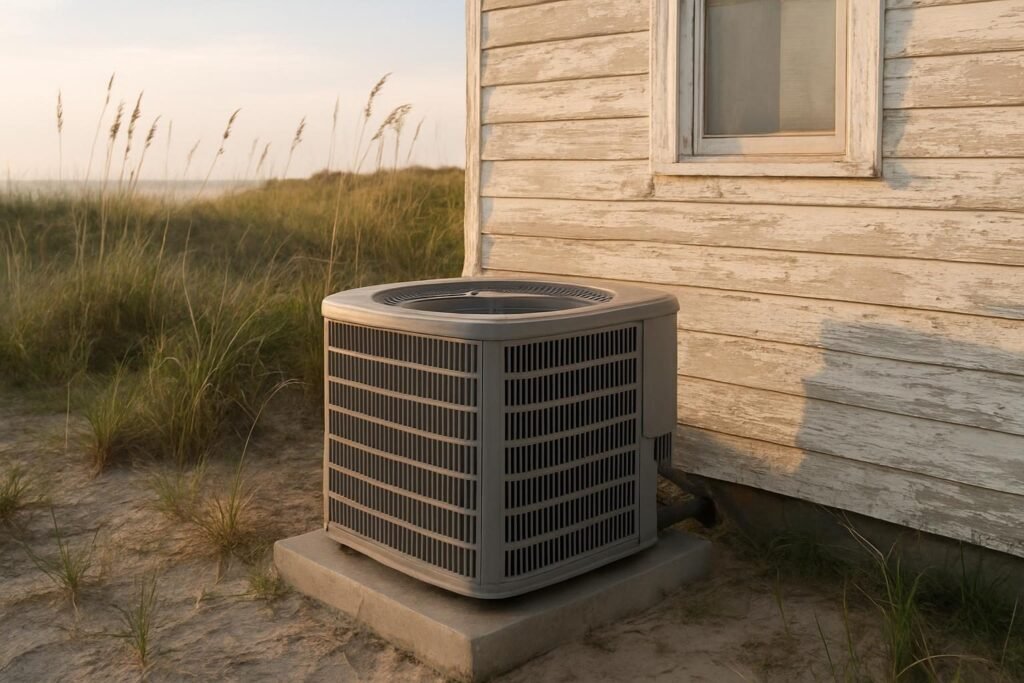
Quick answer: Salt air eats the thin aluminum fins and copper tubing in an outdoor AC condenser, which is why coastal NC units often fail years sooner than the same equipment inland. The best defense is regular fresh-water coil rinsing, a protective coating or coastal-rated unit, and an annual tune-up that checks for early corrosion.
Key takeaways
- Salt corrosion is the main reason coastal AC units wear out early; expect roughly 8 to 12 years instead of the 12 to 15 often quoted inland.
- Oceanfront and sound-front homes face the harshest conditions, but salt travels, so Newport and Cape Carteret units are not immune.
- Gently rinsing the outdoor coil with fresh water every month or two is the cheapest protection you have.
- Coated coils and coastal-rated units cost more up front but are usually worth it close to the water.
- Catching corrosion early, before refrigerant leaks start, can save you from a full replacement.
If you live on Bogue Banks, along the Beaufort waterfront or anywhere the breeze carries that salty smell, your AC condenser is quietly fighting a losing battle. Salt air and HVAC corrosion on the coast of North Carolina is one of the most common reasons homeowners here replace equipment earlier than they expected. The good news is that most of the damage is slow, visible and partly preventable.
If your system is already showing its age, you can request help with HVAC repair from a vetted local pro using the form on this page.
How Salt Air Actually Damages an AC Unit
Your outdoor unit is basically a big radiator. Air gets pulled across a coil made of copper tubing wrapped in thin aluminum fins, and that coil is exposed to whatever is floating in the breeze. Near the ocean or the sounds, that includes salt aerosol from surf, spray and wind-driven moisture.
Salt on its own is not the whole story. When it settles on metal and absorbs humidity, it forms a conductive film that speeds up galvanic corrosion, where two different metals (copper and aluminum) eat away at each other. Coastal humidity keeps that film wet much of the year.
What gets hit first
- Aluminum fins: they pit, flake and crumble, which reduces heat transfer and airflow.
- Copper tubing: pinhole leaks form where corrosion eats through, letting refrigerant escape.
- Cabinet and fan guard: paint blisters and steel rusts, especially at screws and seams.
- Electrical components: contactors, capacitors and wiring connections corrode and cause intermittent failures.
Why some homes get it worse
Distance from the water matters, but so does exposure. A condenser on the sound side of a Pine Knoll Shores lot, or tucked against an oceanfront wall in Emerald Isle, sees far more salt than one behind a house in Cedar Point. Wind direction, open lots and tall dunes or tree cover all change the dose. Storm surge or a hurricane that pushes salt spray inland can also coat equipment miles from the beach in a single event.

Signs Your Coastal AC Is Corroding
Most corrosion problems announce themselves before the unit quits, if you know where to look. A quick walk-around with the power off is worth doing every season.
| What you notice | What it may mean |
|---|---|
| White or gray powdery buildup on the coil | Aluminum oxidation; fins are deteriorating |
| Fins that crumble or flake when touched | Advanced corrosion, reduced efficiency |
| Oily residue or stains near the tubing | Possible refrigerant and oil leak at a pinhole |
| Rust blooms on the cabinet or fan guard | Protective finish is failing |
| Longer run times, weaker cooling | Dirty or damaged coil, or low refrigerant |
| Rising electric bills with no other change | System working harder to move heat |
| Unit short-cycling or tripping the breaker | Corroded electrical connections or a failing component |
A one-time refrigerant top-off on a corroded coil is usually a short-term fix. If the leak is from corrosion, the next pinhole is often not far behind, so ask a technician whether the coil itself is repairable or whether replacement makes more sense.
Coastal-Rated Units, Coatings and Smart Placement
You have three main ways to improve your odds, and they work best together.
Protective coatings
Factory-applied or field-applied anti-corrosion coatings seal the coil and fins so salt cannot sit directly on bare metal. Some manufacturers offer a coated coil option on new equipment. Aftermarket coatings can be applied to an existing, still-healthy coil, but they work best on a clean coil in good shape, not one that is already corroding. Ask the installer exactly what product is used and what the warranty covers, because coating warranties often have conditions about maintenance.
Coastal-rated or corrosion-resistant equipment
Some manufacturers sell lines built for marine environments, with coated coils, stainless or heavily treated hardware and more robust cabinet finishes. These typically cost more than standard equipment; ask for quotes on both and compare what the extra price buys. Within a few blocks of the ocean or directly on the sound, it is often a reasonable upgrade.
Placement and protection
- Keep the unit on a raised pad or stand, in line with flood-zone guidance for your home.
- Position it out of direct, prevailing salt spray when you have a choice, such as the lee side of the house.
- Leave clearance for airflow and for rinsing; do not box it in tightly.
- Skip sealed covers during the season; trapped moisture can make corrosion worse. Ask a pro about storm-time protection.
Local tip: If you are buying a home on Bogue Banks, Harkers Island or anywhere Down East, ask when the outdoor unit was installed and whether it has a coated coil. Salt-exposed equipment older than about eight years is worth a pro’s inspection before you close.
Fresh water and a gentle hand do more for a coastal condenser than any gadget you can buy.
A Practical Maintenance Schedule
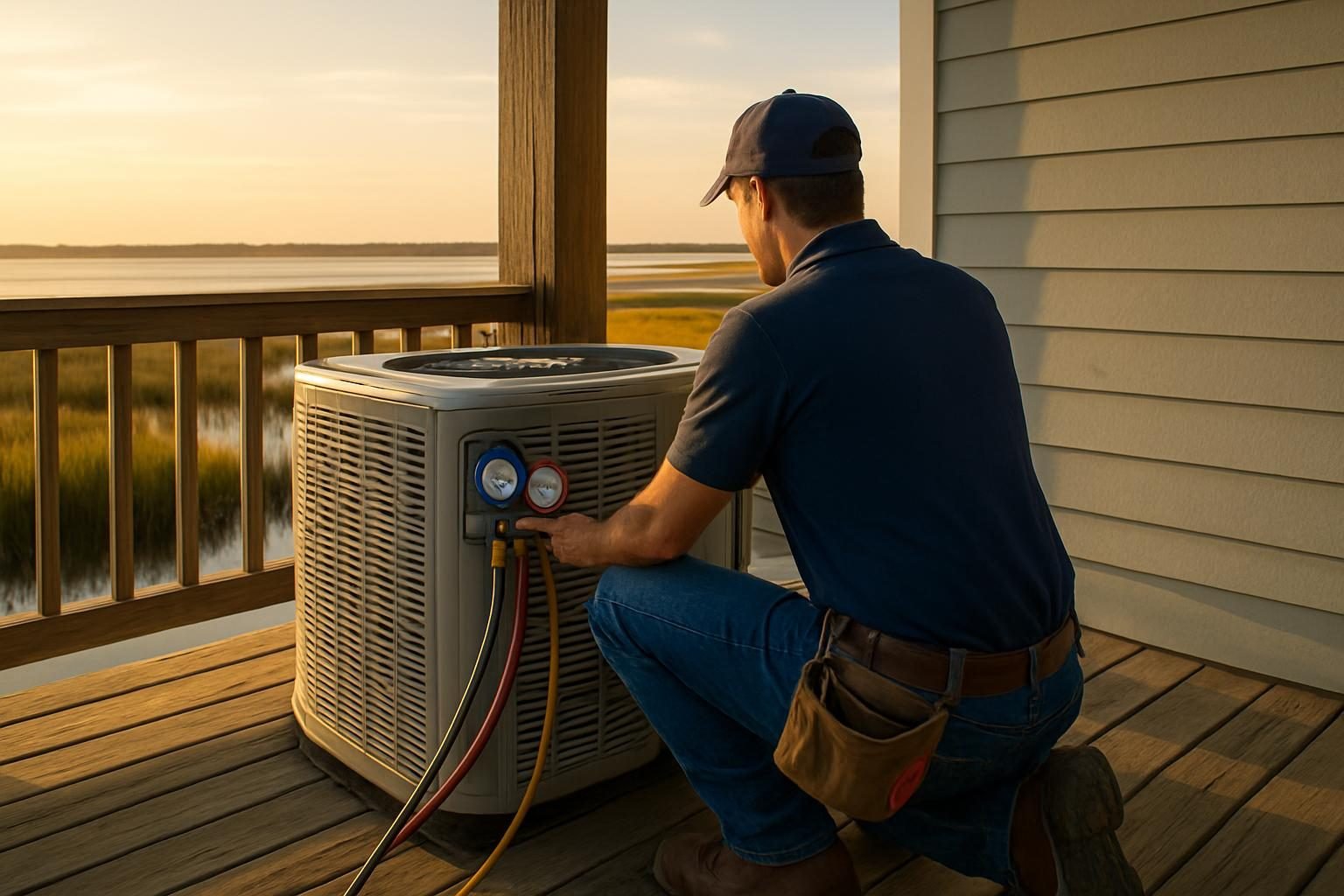
Maintenance is where coastal homeowners can actually change the outcome. Here is a schedule that fits what most local HVAC pros recommend, adjusted to how close you are to the water.
| Task | Oceanfront / sound-front | Elsewhere in the county |
|---|---|---|
| Rinse outdoor coil with fresh water | Every 4 to 6 weeks | Every 2 to 3 months |
| Check and replace indoor air filter | Monthly during heavy use | Every 1 to 3 months |
| Visual inspection for corrosion | Monthly | Each season |
| Professional tune-up and coil check | Twice a year | Once a year, spring |
| Clear debris, plants and sand around unit | Every month | Every month |
| Post-storm rinse and inspection | After any major wind event | After any major wind event |
How to rinse the coil safely
- Turn off power to the outdoor unit at the disconnect and the breaker.
- Remove loose debris from around and on top of the unit by hand.
- Use a garden hose on a gentle shower setting, spraying from the inside out if the panels come off, or from the outside at a low angle.
- Never use a pressure washer; it bends fins and drives salt deeper.
- Let the unit dry fully before restoring power.
Keep your annual tune-up on the calendar before summer. A technician can test refrigerant pressures, check electrical connections for corrosion, and catch a small leak before it becomes a dead compressor in July. If you want a local option, look at HVAC repair in Morehead City and compare quotes.
Lifespan Expectations and Repair vs. Replace
Manufacturers often cite 12 to 15 years for a well-maintained system. On the coast, a realistic range for the outdoor unit is closer to 8 to 12 years, shorter right at the water and longer with a coated coil and consistent rinsing. The indoor air handler, shielded from the weather, often outlasts the condenser. These are estimates, not guarantees, and results vary with exposure and upkeep.
On the coast, the coil usually fails long before the compressor does.
When repair makes sense
- The unit is under about eight years old and corrosion is limited to a fixable component.
- The problem is an electrical part like a capacitor or contactor, not the coil.
- A technician confirms the coil is sound and recommends cleaning or coating.
When replacement is the smarter move
- The coil is leaking and the unit is past roughly 10 years old.
- Fins are crumbling across much of the coil.
- Repair quotes are climbing toward a meaningful share of replacement cost.
- The system uses an older refrigerant that is getting harder and costlier to service.
If you are replacing, ask for a coated or coastal-rated condenser and get at least two written quotes. Check that the installer is licensed in North Carolina through the NC State Board of Examiners of Electrical Contractors and the NC Licensing Board for Heating Group Contractors, and ask about permit requirements with your town or the county. Costs vary widely with system size and brand, so rely on written quotes rather than rules of thumb.
Pairing AC Care With Storm and Home Prep
Salt and storms go together here. Before a named storm, shut off power to the unit at the breaker, and afterward rinse it and check for debris, bent fins and standing water around the pad. Our hurricane prep checklist for Carteret County homes covers the broader steps, and it is worth reading alongside hurricane season in Carteret County if you are new to the area.
Humidity is the other half of the problem. Moisture in a crawl space can load your ducts and system with extra work, which is why crawl space moisture on the NC coast belongs in the same conversation. For a broader look at coastal upkeep, the Home & Property section collects our guides, and the cost of living in Carteret County guide explains why insurance, utilities and maintenance run higher near the water. Seasonal heat and humidity also drive your cooling load, so the Crystal Coast weather by month breakdown helps you plan when to service equipment.
If you are weighing a move, the complete guide to moving to Carteret County covers what else to budget for coastal homeownership. When you are ready to get your system checked or replaced, request help with HVAC repair from a vetted local pro, and browse the Local Pros hub for other home services.
FAQ
How often should I rinse my AC unit on the Crystal Coast?
Every 4 to 6 weeks if you are oceanfront or sound-front, and every 2 to 3 months elsewhere in the county. Use a gentle garden hose with the power off, never a pressure washer.
Does a coated coil really help?
Yes, a quality anti-corrosion coating slows salt damage by keeping salt off bare metal. It works best combined with regular rinsing and professional maintenance, and it is not a substitute for either.
How long do AC units last near the ocean in NC?
Outdoor units commonly last about 8 to 12 years on the coast, versus 12 to 15 inland. Close exposure, poor maintenance and no coating push the lifespan toward the low end.
Should I cover my AC unit to keep salt off?
Generally no. Sealed covers trap moisture and can speed corrosion. Ask a technician about storm-time protection, and rinse and inspect the unit after major wind events. For the house itself, see our guide to wind-resistant roofs on the NC coast.
Can salt air void my HVAC warranty?
Some warranties limit or exclude corrosion damage, especially in coastal installs without required maintenance. Read the terms and ask the installer what is covered before you buy.
Get AC repair help in Morehead City and Carteret County
Tell us what your system is doing and a vetted local HVAC pro will follow up to schedule a visit.